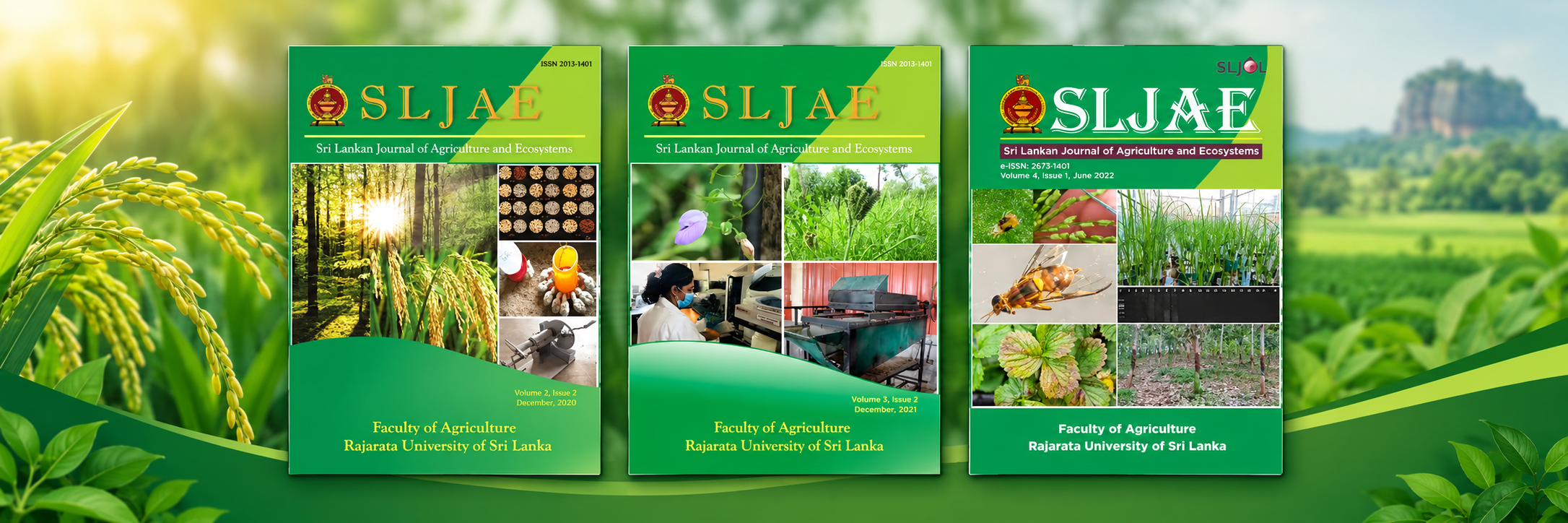
Sri Lankan Journal of Agriculture and Ecosystems
Editorial Policy, Publication Ethics, Author Guidelines and Reviewer Guidelines
Revised 2026
Journal Policies & Guidelines
The Sri Lankan Journal of Agriculture and Ecosystems (SLJAE) publishes original, peer-reviewed research, reviews and short communications across agriculture and allied ecosystem sciences. These guidelines provide essential information for authors, reviewers and editors to maintain the quality, transparency and integrity of scholarly publishing.
Semi-Annual
Published twice a year
Open Access
Free access to published articles
Double-Blind
Peer-review process
No Publication Fees
No APC or submission fee
01. Editorial Policy & Publication Ethics
Editorial governance, ethical publishing practices, transparency and responsibilities of all parties.
1.1 Journal Governance
SLJAE is governed by an Editor-in-Chief and an Editorial Board of subject specialists, supported by the Faculty of Agriculture, Rajarata University of Sri Lanka, as the publisher.
The journal is published semi-annually in electronic format. Special issues and calls for papers may also be issued, subject to Editorial Board approval.
1.2 Open Access Statement
All published content is freely available immediately upon publication.
- No article processing charges (APC) are levied on authors.
- Articles are published under the Creative Commons Attribution 4.0 International License (CC BY 4.0).
- Published content can be accessed without subscription fees.
1.3 Publication Ethics and Responsibilities
SLJAE follows the COPE Core Practices and the COPE Code of Conduct and Best Practice Guidelines for Journal Editors.
Responsibilities of the Editor-in-Chief and Editorial Board
- Make decisions based on academic merit, originality, scientific soundness, clarity and relevance to the journal’s scope.
- Maintain transparency, competency and fairness in editorial decisions.
- Evaluate manuscripts for scope, originality and plagiarism before peer review.
- Ensure a rigorous double-blind peer-review process.
- Maintain confidentiality of submitted manuscripts.
- Never use unpublished manuscript material for personal research without written consent.
- Respond appropriately to ethical concerns and investigate allegations of misconduct.
- Maintain a database of qualified peer reviewers.
- Provide and periodically update ethical guidance.
- Ensure editors who are authors of submitted manuscripts take no part in handling those manuscripts.
Responsibilities of the Publisher
The Faculty of Agriculture, Rajarata University of Sri Lanka, as publisher, is responsible for:
- Safeguarding editorial independence.
- Protecting intellectual property, copyright and privacy.
- Providing infrastructure and technical and administrative support.
- Supporting ethical standards and investigations of misconduct.
1.4 Handling Allegations of Misconduct
Allegations concerning submitted or published articles are investigated by the Editor-in-Chief and Editorial Board following COPE guidance. The author’s institution may be contacted where appropriate.
The identity of persons raising good-faith allegations is kept confidential to the extent possible.
Possible outcomes include:
- Rejection of the manuscript.
- Request for revision.
- Correction or clarification.
- Expression of Concern.
- Retraction.
1.5 Conflict of Interest Policy
A conflict of interest exists when financial, personal, professional or institutional interests could influence judgement relating to a manuscript.
- Authors: Must disclose all financial and non-financial conflicts and research funding.
- Reviewers: Must decline or disclose conflicts involving competing, collaborative or close personal/professional relationships.
- Editors: Must recuse themselves and delegate decisions where a conflict exists.
1.6 Corrections, Expressions of Concern and Retractions
SLJAE follows COPE guidance to maintain the integrity of the published record.
Errata / Corrigenda
Significant but non-invalidating errors, such as incorrect author names, affiliations, figures or data points, may be corrected. The original article remains online with a linked correction.
Expression of Concern
An Expression of Concern may be published when credible evidence of a serious problem exists but an investigation is incomplete.
Retraction
Retraction may be considered where:
- Research findings are unreliable due to misconduct or honest error.
- The work has been plagiarised or published redundantly.
- The research was conducted unethically or without required approval.
- Findings have previously been published without disclosure.
Retracted articles remain accessible online with a clearly linked retraction notice explaining the reason.
Reporting a Concern
Authors, readers and third parties should contact the Editor-in-Chief in writing, describing the concern and providing supporting evidence where possible.
1.7 Complaints and Appeals
Authors may submit written complaints or appeals regarding editorial decisions or the peer-review process to the Editor-in-Chief, stating the specific grounds and supporting evidence.
- Appeals against rejection are considered only where a specific procedural issue or substantive scientific point has been inadequately addressed.
- Complaints about the Editor-in-Chief are referred to another senior Editorial Board member designated for this purpose.
- Appeals are not a route for resubmitting an unrevised manuscript.
- Acknowledgement within 10 working days.
- Substantive response within 6 weeks.
02. Author Guidelines
Information for preparing and submitting manuscripts to the Sri Lankan Journal of Agriculture and Ecosystems.
2.1 Aims and Scope
SLJAE publishes original, peer-reviewed research articles, reviews and short communications across agriculture and allied ecosystem sciences.
Research areas include:
- Crop science and forestry.
- Agricultural biology and plant protection.
- Genetics and plant breeding.
- Food science and nutrition.
- Animal science.
- Soil science and water resource management.
- Agricultural engineering and machinery.
- Agricultural economics and extension.
- Agro-ecosystem studies.
Research relevant to Sri Lanka and South Asia is particularly welcome. Submissions from other regions are also considered when they provide clear scientific or practical contributions.
2.2 Responsibilities of Authors
By submitting a manuscript, authors agree to:
- Submit only original work not published or under review elsewhere, except as explicitly disclosed and approved by the Editor.
- Ensure all research data are authentic and accurately reported.
- Properly cite and acknowledge other people’s work, ideas, data and figures.
- Ensure all listed authors meet authorship criteria and approve the final manuscript.
- Disclose financial and non-financial conflicts of interest and funding sources.
- Obtain documented ethical approval for research involving human participants, human data or live animals, where applicable.
- Respond promptly to editorial queries, reviewer comments and requests for underlying data.
2.3 Authorship Criteria
SLJAE follows internationally recognised authorship criteria consistent with ICMJE recommendations. Authors must meet all four conditions:
- Substantial contribution to conception or design, or acquisition, analysis or interpretation of data.
- Drafting the work or critically reviewing it for important intellectual content.
- Final approval of the version to be published.
- Agreement to be accountable for all aspects of the work and ensure integrity-related concerns are appropriately investigated and resolved.
The corresponding author must ensure that all co-authors approve the final manuscript and that author names and order are accurate.
Changes to authorship after submission require written justification and consent from all authors, including anyone added or removed.
2.4 Plagiarism, Data Integrity and Research Misconduct
SLJAE does not tolerate plagiarism, image manipulation, fabrication, falsification or other research and publication misconduct.
Plagiarism Screening
- All submissions undergo a similarity/plagiarism check before peer review.
- A similarity score is a screening indicator and is evaluated in context.
- An overall similarity index above 20%, excluding references, quotations and standard methodological phrasing, will normally require clarification or revision, or otherwise may result in rejection.
- Substantial unattributed overlap with a single source may also result in clarification, revision or rejection.
Data and Image Integrity
- Authors must accurately represent underlying data and research findings.
- Images must not be manipulated to alter, obscure, move, remove or introduce specific features.
- Brightness, contrast and colour adjustments are acceptable only when applied uniformly to the entire image and disclosed.
- Raw data must be retained and made available to Editors on reasonable request.
Duplicate Publication and Salami Slicing
Submitting substantially the same paper to multiple journals, or artificially dividing a coherent study into minimal publications, is considered misconduct.
Predatory Journal References
Authors should avoid citing predatory or non-legitimate journals. Where legitimacy is uncertain, authors are advised to verify the journal through DOAJ or COPE.
Misconduct allegations are investigated by the Editor-in-Chief and Editorial Board following COPE guidance.
2.5 Conflict of Interest
Authors must disclose all financial and non-financial conflicts of interest and research funding in a dedicated statement in the manuscript and in the required submission documents.
“The authors declare no conflict of interest.”
2.6 Use of Artificial Intelligence (AI) Tools
SLJAE requires transparency in the use of AI and AI-assisted technologies during research and manuscript preparation.
- Use of AI for summarisation, literature searching, data analysis, code generation or figure preparation must be disclosed.
- Disclosure should normally appear in a statement before the Acknowledgements.
- AI tools must not be listed as authors or co-authors.
- Human authors remain fully responsible for accuracy, originality and integrity.
- AI-generated text, analysis, images and code must be critically checked and verified for accuracy, bias and inadvertent plagiarism.
- AI must not be used to fabricate or manipulate research data.
- AI used as part of the research methodology, such as machine-learning analysis, must be fully described in the Methods section.
2.7 Research Ethics, Biodiversity and Environmental Compliance
Human Participants and Human Data
- Research involving human participants, human data or tissue requires approval from an appropriate institutional or national ethics committee.
- The Methods section must identify the approving body and approval/reference number.
- A copy of the ethical clearance certificate must accompany the manuscript.
- Informed consent must be obtained, and participants must be identified by number or pseudonym rather than name.
- Interventional studies should be registered with an appropriate trial registry, such as the Sri Lanka Clinical Trials Registry, before enrolment.
Animal Research
Research involving live animals must comply with relevant institutional, national or international animal-care guidelines. The approval reference must be cited in the manuscript.
Molecular Sequence Data
Gene, rDNA, genome and metagenomic sequence data must be deposited in a public INSDC-affiliated repository such as GenBank. Accession numbers must be cited.
Biological Specimens and Protected Areas
Collection of biological specimens, including from protected areas or threatened/endangered species, must comply with applicable laws and permit requirements. The issuing authority, permit/reference number and relevant protected area or species status must be reported.
2.8 Data Availability Policy
SLJAE encourages, and for original research articles requires, a Data Availability Statement after the Conclusions and before the References.
Acceptable statements include:
- Data are deposited in a public repository and available through a DOI/URL.
- Data are included within the article or supplementary information files.
- Data are available from the corresponding author upon reasonable request.
- Data are not publicly available for a specific reason, such as participant privacy, but summary data may be requested.
- Not applicable — no datasets were generated or analysed in this study.
Third-party datasets should include persistent identifiers, such as DOIs, in the reference list.
2.9 Reviewer Suggestions
Authors must nominate at least three potential reviewers in the cover letter.
- Provide full names.
- Provide current institutional affiliations.
- Provide valid, functioning email addresses.
- Suggested reviewers must not be current or recent collaborators/co-authors within the last three years.
- Suggested reviewers must not be from the same institution as any author.
The journal is not obliged to approach suggested reviewers and may independently select reviewers.
2.10 Manuscript Categories and Length Limits
| Manuscript Category | Description | Length Limit |
|---|---|---|
| Regular / Original Research Articles | Complete original research reports with Introduction, Materials and Methods, Results and Discussion, and Conclusions. | ≤ 8,000 words (text + references), or approximately 25 pages including figures/tables. |
| Short Communications | Concise reports of significant, focused findings, reviewed with the same rigour as full articles. | ≤ 2,000 words, or approximately 8 pages including figures, tables and references. |
| Review Articles | Critical, well-focused synthesis of a defined topic. The lead author should have a demonstrable publication record in the area. | ≤ 10,000 words including figures, tables and references. |
| Editorials / Invited Commentary | Invited pieces on topics of current relevance to the journal’s scope. | At the Editor’s discretion. |
Manuscripts exceeding the stated limits may be returned for shortening before further consideration.
2.11 Manuscript Preparation Guidelines
General Formatting
- Manuscripts must be written in clear, grammatically correct English.
- British or American spelling may be used consistently.
- Submit in Microsoft Word format (.docx preferred; .doc accepted).
- Use Segoe UI throughout the manuscript.
- Main text: 11-point font.
- Line spacing: 1.5 with justified alignment.
- Margins: 2.54 cm (1 inch) on all sides.
- Paper size: A4.
- Number pages consecutively using automatic page numbering.
- Apply continuous line numbering throughout the manuscript.
- Use decimal section numbering with a maximum of three heading levels.
- Use tab stops rather than spaces for indentation.
- Create tables using the Microsoft Word table function.
- Prepare equations using Microsoft Equation Editor or MathType.
Formatting of Manuscript Elements
| Element | Required Formatting |
|---|---|
| Manuscript title | 14 pt, bold, Title Case |
| Author names | 11 pt, bold, Title Case |
| Author affiliations | 11 pt, italic |
| Abstract heading | 12 pt, bold, UPPERCASE |
| Abstract text | 10 pt, regular |
| Main text | 11 pt, regular |
| First-level headings | 12 pt, bold, UPPERCASE |
| Second-level headings | 12 pt, bold, Title Case |
| Third-level headings | 12 pt, bold, Sentence case |
| Figure captions and table titles | 10 pt, bold, Sentence case |
| Conclusions and References | 11 pt, regular |
| Footnotes | 9 pt, italic |
| Keywords | 10 pt, italic, Title Case, comma-separated |
Title Page (Separate File)
- Concise and informative manuscript title.
- Short running title (recommended ≤ 50 characters).
- Full names, affiliations and addresses of all authors.
- Corresponding author’s details and email address.
- ORCID ID for every author; corresponding author’s ORCID is mandatory.
- Acknowledgements.
- Funding statement.
- Author contribution statement (recommended).
Abstract and Keywords
- Abstract: one paragraph of 200–250 words.
- Self-contained, with no undefined abbreviations or citations.
- Include objectives, methodology, key results and principal conclusions.
- Maximum six keywords, in alphabetical order.
- Avoid repeating words already used in the title.
Body Structure
Original research articles should generally follow:
- Introduction: Rationale, objectives and focused review of relevant literature.
- Materials and Methods: Sufficient detail for replication, statistical methods and ethical approvals.
- Results and Discussion: Concise results and interpretation in relation to existing literature.
- Conclusions: Brief, aligned with objectives and without new references.
Abbreviations, Nomenclature and Units
- Define non-standard abbreviations at first use.
- Use SI units throughout.
- Italicise genus, species and infraspecific scientific names.
- Provide scientific name authorities at first mention.
- Use generic rather than trade names for drugs and pesticides.
- Follow standard mathematical notation conventions.
Tables and Figures
- Number tables and figures consecutively using Arabic numerals.
- Provide self-explanatory captions.
- Cite previously published material appropriately.
- Embed editable tables and figures at appropriate locations.
- Figures must have at least 300 dpi resolution.
- Label composite figures as a, b, c, etc.
- Photographs and micrographs must include a clear scale bar.
Supplementary Materials
Additional data, extended methods, tables and figures may be submitted as supplementary files and will be made available alongside the article.
Revised Manuscripts
Authors must submit a separate, tabulated, point-by-point response to reviewer and Editor comments. Each response should describe the corresponding changes and provide page and line numbers where appropriate.
2.12 Reference Style – APA 7th Edition
SLJAE uses the American Psychological Association (APA), 7th edition, for both in-text citations and reference lists.
In-text citation examples
- Single author: (Rai, 2010)
- Two authors: (Abeysingha & Perera, 2015)
- Three or more authors: (Abeysingha et al., 2015)
- Narrative citation: Abeysingha et al. (2015) reported …
Reference List Requirements
- Title the section “References”.
- Include only works cited in the manuscript and ensure every in-text citation has a corresponding reference.
- Arrange references alphabetically by first author’s surname.
- Use a hanging indent.
- Personal communications and unpublished work may be cited in text only where no suitable published source exists.
- Newspaper articles are not accepted as valid scholarly references.
- Footnotes/endnotes must not replace the reference list.
Digital Object Identifiers (DOIs)
Include a DOI for every reference where one has been assigned, using its full link format:
Where a DOI is unavailable, provide the full source URL and access date for undated or changeable web content.
Authors are encouraged to verify open-access journals through DOAJ or COPE.
2.13 Copyright and Open Access Licensing
- All SLJAE articles are licensed under Creative Commons Attribution 4.0 International (CC BY 4.0).
- Authors must complete a copyright/licence-to-publish agreement upon acceptance.
- Authors retain the right to reuse their published work in a thesis or subsequent publication with appropriate citation of the original SLJAE publication.
- Authors must obtain written permission for third-party copyrighted material before submission.
2.14 Publication Fees
SLJAE currently does not charge any APC or submission fee.
If this policy changes, the fee schedule and waiver policy for authors from low-resource settings will be published transparently in advance. Fees will not be introduced retroactively for manuscripts already under review.
2.15 Author Submission Checklist
Before submitting your manuscript, confirm the following:
- The manuscript has not been published or submitted elsewhere, or any overlap has been disclosed.
- The main manuscript is anonymised for double-blind review.
- A separate title page includes author details and ORCID IDs.
- Abstract, keywords and manuscript structure follow journal guidelines.
- Tables and figures are correctly numbered and cited.
- References follow APA 7th edition consistently.
- DOIs are included wherever available.
- Conflict of Interest Statement is included.
- Data Availability Statement is included.
- AI-tool use has been disclosed where applicable.
- Ethical clearance documents are attached where applicable.
- Cover letter includes at least three potential reviewers with contact details.
- Author contributions are described.
- Signed Authors’ Agreement/Declaration Form and Conflict of Interest form are ready.
- Third-party copyrighted material has appropriate permissions and credit lines.
03. Reviewer Guidelines
Responsibilities and procedures for maintaining objective, confidential and constructive peer review.
3.1 Role of Reviewers
Peer reviewers play a central role in maintaining the scientific quality and integrity of SLJAE. Reviewers are expected to provide fair, timely and constructive assessments following COPE’s Ethical Guidelines for Peer Reviewers.
- Author and reviewer identities remain concealed from one another.
- Manuscripts passing initial screening are assigned to at least two independent subject experts.
- Reviewers are given 14 working days to complete their reviews.
- The overall review process typically takes 4–8 weeks.
- The process will not normally exceed 12 weeks from submission to first decision.
3.2 Responsibilities of Reviewers
- Recognise peer review as an ethical and professional responsibility.
- Assist the Editor in reaching fair editorial decisions.
- Provide constructive feedback to improve manuscripts.
- Notify the Editor promptly if unable to complete a review and suggest an alternative qualified reviewer where possible.
- Conduct reviews objectively and professionally.
- Avoid personal criticism or comments unrelated to scientific content.
- Provide specific, clear and evidence-based comments.
- Maintain strict confidentiality during and after the review process.
- Never contact authors directly.
- Declare conflicts of interest and decline reviews where appropriate.
3.3 Instructions for Conducting the Review
Reviewers are asked to evaluate whether:
- The research or review is well designed, executed and appropriately powered/replicated.
- The title accurately reflects the manuscript content.
- The research question and rationale are clearly presented in the Introduction.
- Methods are described in sufficient detail to permit replication.
- Data are unambiguous and correctly analysed.
- Conclusions are supported by the presented results.
- The manuscript contributes new knowledge and is relevant to the journal’s scope.
- Relevant previous research has been appropriately cited.
3.4 Use of AI Tools in Preparing Reviews
Reviewers must not upload a manuscript or any part of its content to a generative AI tool.
- AI tools may be used for general language polishing of reviewers’ own comments.
- Substantive AI use in scientific assessment, including evaluating methodology, interpreting results or drafting substantive critique, must be disclosed to the Editor-in-Chief.
- AI-generated text must be checked, edited and approved by the reviewer.
- The reviewer remains fully accountable for all review content, judgments and recommendations.
3.5 Reporting Concerns
Any suspicion of plagiarism, data fabrication, falsification, undisclosed conflicts of interest or other ethical concerns should be reported directly and promptly to the Editor handling the manuscript.
Concerns should not be raised directly with the authors. Allegations are handled according to the journal’s Editorial Policy and COPE guidance.