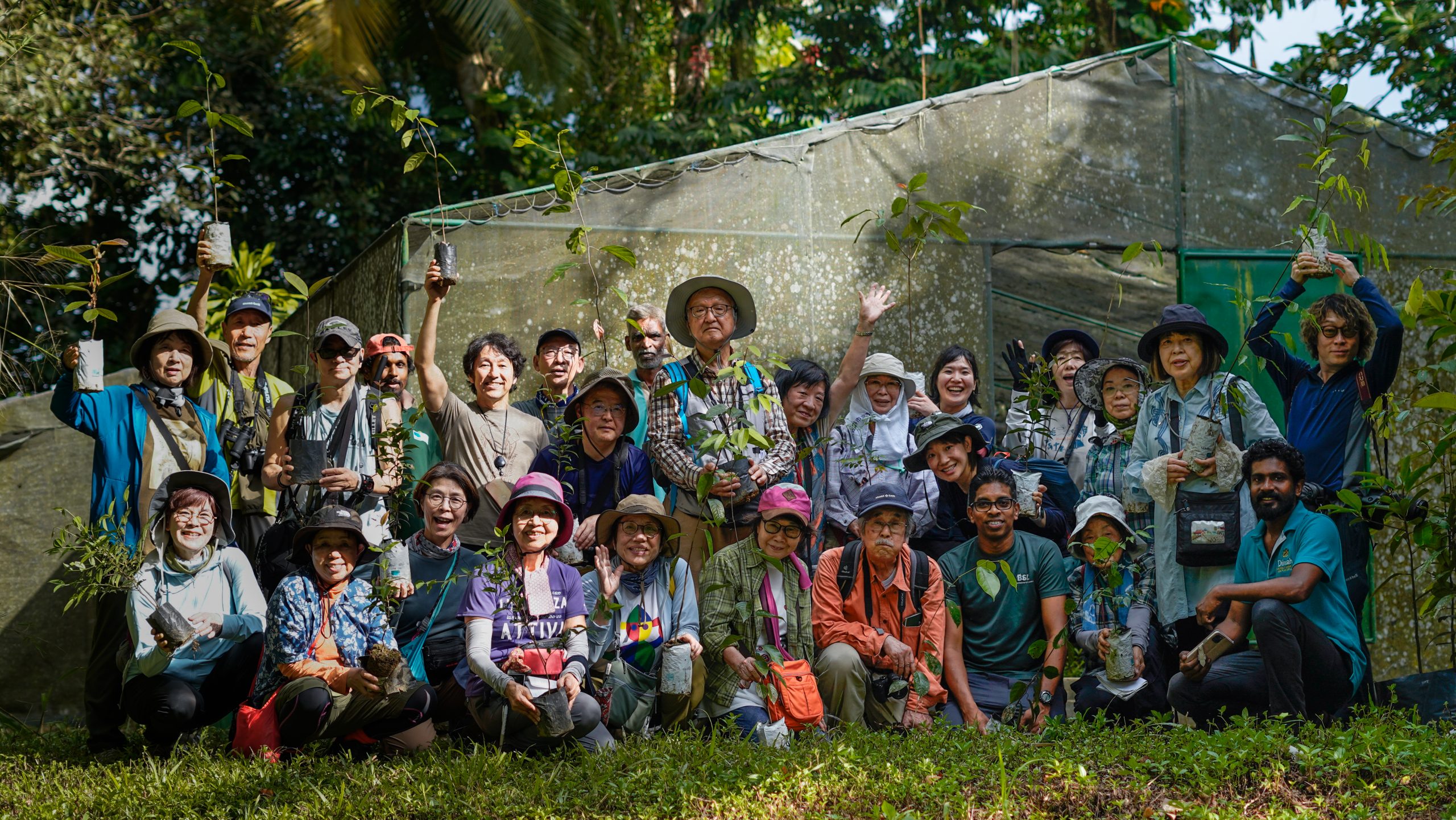
A team of 23 Japanese nature enthusiasts from Kyoto, Japan, led by Hiroyuki Watanabe, recently visited the Endane Biodiversity Corridor to experience firsthand the ongoing rainforest restoration and conservation efforts within the Sinharaja Forest Landscape.
Professor Watanabe, a plant ecologist and former leader of the Tropical Forest Resources and Environment Laboratory at Kyoto University, led the delegation of nature lovers who were deeply interested in tropical rainforest ecosystems and ecological restoration.
During their visit to the Endane Field Research Station, the group learned about the corridor’s pioneering work in restoring threatened rainforest tree species. The visitors expressed great appreciation for the conservation and restoration initiatives carried out through the flagship threatened plant nursery, which plays a critical role in safeguarding Sri Lanka’s rare rainforest flora.
As part of the visit, the group actively participated in a symbolic restoration activity, planting approximately 25 seedlings representing 18 threatened rainforest tree species, contributing directly to the ongoing ecological restoration of the corridor.
The visit and field logistics were thoughtfully arranged by Amila Perera, Centre Coordinator of Dilmah Conservation, and his dedicated team. Nalaka Geekiyanage from the Rajarata University of Sri Lanka participated as the resource person, sharing insights into the ecological significance of rainforest restoration and the long-term monitoring efforts underway in the corridor.
The Endane Biodiversity Corridor was initiated by Merrill J. Fernando, the founder of Dilmah Ceylon Tea Company PLC, as a visionary initiative to restore connectivity in the Sinharaja Forest Landscape. The project is co-financed by Dilmah Ceylon Tea Company PLC and the Franklinia Foundation, and is implemented collaboratively by Dilmah Conservation and the Rajarata University of Sri Lanka.
This visit highlights the growing international appreciation for Sri Lanka’s rainforest restoration efforts and the importance of global collaboration in conserving biodiversity-rich tropical ecosystems.